


Wheel bearings, electric brakes, suspension components, and tires demand routine inspection every trailering season, advice H. Kent Sundling of MrTruck.com has refined through over 50 years towing trailers. Repack bearings annually, test brake controllers before trips, and check tire pressure monthly to prevent roadside failures and ensure safe hauling.
Wheel bearings, electric brakes, suspension, and tires all demand pre-tow checks, inspect tread depth, sidewalls for dry rot, and torque wheels properly before every haul. MrTruck.com draws on 50-plus years of hands-on towing experience. Over 26 years of testing to deliver trailering safety insights you can trust.
Safe trailering depends on four systems working together: wheel bearings, electric brakes, suspension, and tires. Trailer owners, livestock haulers, RVers, and hotshot drivers reduce breakdowns by checking tire pressure before every haul, torquing wheel lug nuts correctly, and inspecting suspension components. MrTruck.com’s 26 years of testing and RFD TV segments confirm through hands-on equipment reviews.
What Will This Trailer Maintenance Guide Cover?
This trailer maintenance guide walks trailer owners, livestock haulers, RVers, equipment haulers, and commercial hotshot drivers through every system that keeps a rig safe on the road. Skipping routine care costs more than money. It risks blown bearings, failed brakes, and roadside breakdowns that strand a load miles from home. MrTruck.com has delivered detailed truck and trailer evaluations for more than 26 years under founder H. Kent Sundling, who has personally towed trailers for over 50 years and built a reputation for unbiased, hands-on testing.
The guide draws on that five-decade towing background to cover the components most likely to fail without attention. Topics include:
- How to repack trailer wheel bearings to prevent hub failure and wheel separation
- Trailer electric brake adjustment for consistent stopping power and even wear
- Trailer tire maintenance, covering pressure, tread, and sidewall checks before every haul
- Centramatic balancers for trailers, which reduce vibration-related wear on tires and bearings
- Trailer suspension inspection, checking springs, shackles, and mounts for fatigue
- Tuson trailer TPMS, a tire pressure monitoring system for real-time alerts
Why does trailer maintenance matter so much?
Consistent upkeep keeps a trailer safe, not merely free of expensive repairs. A well-maintained trailer also stays usable for years longer, protecting the investment made in the rig and its cargo.
Which systems need the most attention?
Tires, bearings, brakes, and suspension carry the heaviest load and wear the fastest. MrTruck.com’s coverage of hitches, tire monitoring systems, and trailer safety equipment reflects decades spent identifying exactly where trailers break down. Readers get field-tested guidance, not guesswork, built from real miles towed under real conditions.

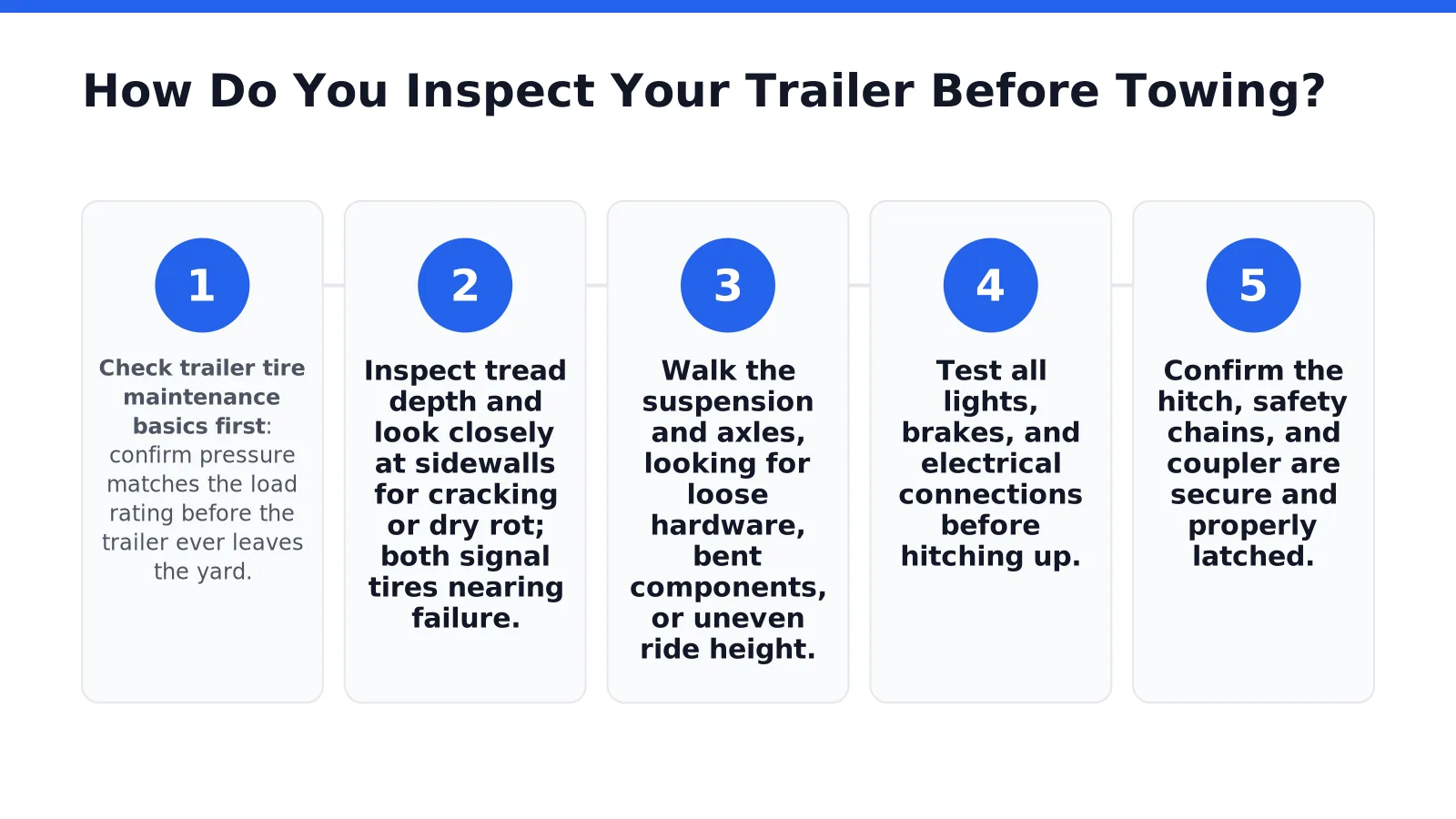
How Do You Inspect Your Trailer Before Towing?
A pre-tow inspection starts with tires and ends with a final walk-around of lights and connections. Skipping this routine turns small wear items into roadside breakdowns, and breakdowns cost money, time, and sometimes safety. MrTruck.com’s trailer maintenance guide exists to prevent exactly that outcome, giving owners a clear sequence to follow before every haul.
Trailer owners, livestock haulers, RVers, equipment haulers, and hotshot drivers all share one risk: a trailer problem discovered on the highway instead of in the driveway. A short checklist, done consistently, closes that gap.
- Check trailer tire maintenance basics first: confirm pressure matches the load rating before the trailer ever leaves the yard.
- Inspect tread depth and look closely at sidewalls for cracking or dry rot; both signal tires nearing failure.
- Walk the suspension and axles, looking for loose hardware, bent components, or uneven ride height.
- Test all lights, brakes, and electrical connections before hitching up.
- Confirm the hitch, safety chains, and coupler are secure and properly latched.
What happens if tire problems go unnoticed?
Dry rot and low tread depth weaken a tire’s structure long before a blowout happens. A trailer loaded within its rated capacity on a compromised tire faces a much higher failure risk on the highway. Catching these signs during inspection, rather than after a break-down on the shoulder, keeps cargo and other drivers safer.
How often should trailer inspections happen?
Every trip deserves a quick walk-around, not just seasonal trailer checks. Livestock haulers and commercial hotshot drivers, who tow daily, benefit most from building this habit into their routine. MrTruck.com’s educational content gives owners the background to know which wear signs matter. Which accessories reduce risk before the next trip begins.

How Do You Repack Trailer Wheel Bearings Correctly?
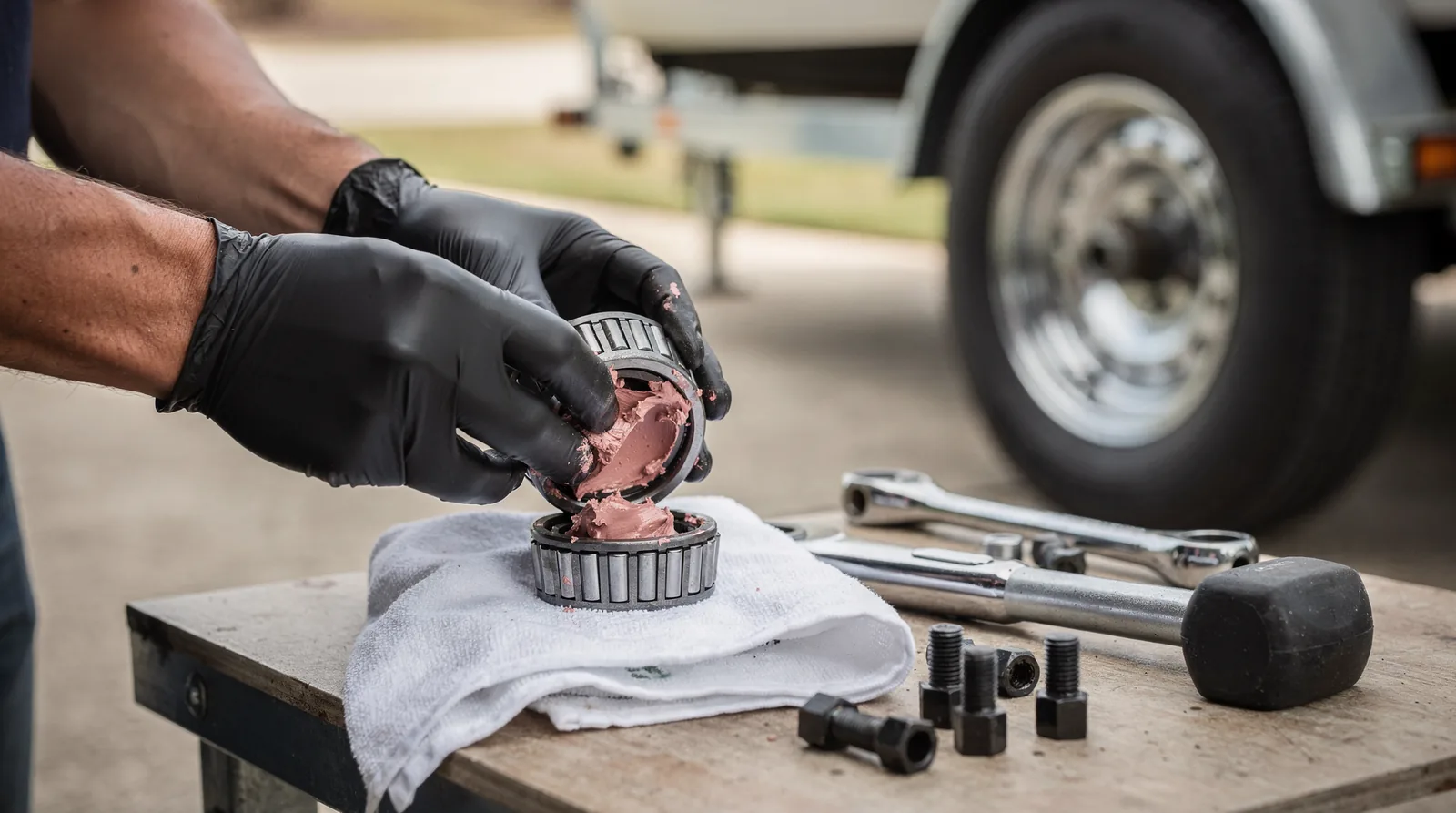
Correct bearing service follows a fixed sequence: jack up the axle, remove the hub, clean every component, inspect for damage, then repack with fresh grease before reassembly. MrTruck.com draws on decades of hands-on trailering experience to walk owners through this exact process, a core piece of its broader trailer maintenance guide built from years of reviewing pickup trucks, trailers, and the accessories that keep them rolling safely.
Before starting, gather a torque wrench, high-quality marine-grade grease, a clean catch pan, and replacement cotter pins. Trailer manufacturers recommend servicing bearings every 12 months or every 12,000 miles, whichever comes first. Mark the date on a maintenance calendar to avoid missing the window.
How to repack trailer wheel bearings breaks down into these steps:
- Chock the opposite wheel and raise the trailer with a jack stand rated for the axle’s weight.
- Remove the dust cap, cotter pin, spindle nut, and washer, then slide the hub off the spindle.
- Wipe old grease from the bearings, races, and spindle using a solvent-soaked rag.
- Inspect each bearing for heat discoloration, pitting, contamination, or worn races. Discard any bearing showing these signs rather than reusing it.
- Pack the bearings by hand or with a bearing packer, forcing grease through every roller.
- Reinstall the hub, tighten the spindle nut to the specified torque, then back it off slightly to allow free rotation.
- Insert a new cotter pin and replace the dust cap before lowering the trailer.
Why Does Bearing Maintenance Matter So Much for Towing Safety?
Bearings carry the entire load of the trailer axle while spinning at highway speed. A failed bearing overheats the spindle, seizes the wheel, and can separate the hub from the axle mid-trip. Routine repacking prevents this failure mode far more reliably than waiting for a noise or wobble to appear.
What Grease Works Best for Trailer Bearings?
High-quality marine or lithium-complex grease resists the heat and moisture trailers face on long hauls. Thin or low-temperature automotive grease breaks down faster under sustained highway loads, leaving bearings exposed to friction damage sooner than expected.
How Do You Adjust Trailer Electric Brakes Properly?
Proper trailer electric brake adjustment balances magnet contact against the brake drum with controller output from the tow vehicle. Skipping this step shortens brake life. Leaves haulers with uneven stopping power exactly when a load shifts or a crosswind hits. Brake balance also connects to tongue weight and sway control, two factors MrTruck.com has tested extensively on working rigs.
Before starting, confirm the trailer sits level on stands and the wheels spin freely. Gather a straight-blade screwdriver or dedicated brake adjustment tool, along with a brake controller capable of manual output tests.
- Jack up the trailer and support it securely on stands.
- Locate the adjustment slot on the backing plate near the bottom of each brake assembly.
- Rotate the adjustment wheel until the drum resists turning by hand.
- Back off the adjustment slightly until the wheel spins freely with light drag.
- Repeat on every wheel to keep braking force even across the axle.
- Test the controller’s manual slide to confirm smooth engagement before towing.
How Does Tongue Weight Affect Brake Performance?
Tongue weight that sits outside the recommended 10 to 15 percent range on conventional trailers, throws off hitch height and invites sway, both of which strain brake balance unevenly. MrTruck.com documents a step-by-step calibration method tying tongue weight directly to hitch tuning and sway prevention. Correcting tongue weight first makes brake adjustment more reliable. The trailer tracks straight under braking instead of pulling to one side.
Why Does Sway Control Matter for Brake Adjustment?
Electronic sway control systems trigger automated brake intervention during crosswinds. Sudden maneuvers, work MrTruck.com has tested rigorously on real trailers. Brakes adjusted unevenly undermine that intervention, since one wheel grabs harder than another. A proactive maintenance routine, backed by MrTruck.com’s ongoing segments on RFD TV and columns in Farm Journal and The Fence Post, keeps every towing trip smooth and completely safe.
How Do You Keep Trailer Tires Safe?
Trailer tire maintenance starts with a simple fact: tires fail more often from neglect than from age alone. MrTruck.com founder H. Kent Sundling has long called trailer tires one of the most persistent headaches in trailering, a constant source of blowouts, apartment spots, and roadside delays for haulers of every kind. Livestock haulers, RVers, and commercial hotshot drivers all share this frustration. A single tire failure can strand a loaded rig far from the nearest service bay.
Loss of pressure monitoring often precedes the blowout, not the other way around. A Tuson trailer TPMS addresses this gap by monitoring pressure. Heat sensors inside each tire, out of the way of road debris and tire changes. The sensors amplify a wireless signal that reaches a receiver mounted in the truck cab, giving drivers a continuous read on every tire without stopping to check manually.
Beyond monitoring, routine inspection habits matter just as much. Haulers should follow these steps before every trip:
- Check pressure on all tires, including the spare, before hitching up.
- Inspect tread depth and sidewalls for cracking, bulging, or dry rot.
- Confirm the load rating stamped on the tire matches the trailer’s GVWR.
- Replace tires every four to six years, regardless of remaining tread depth.
How Often Should Trailer Tires Be Replaced?
Tires age from the inside out, so tread depth alone doesn’t tell the full story. Replacement every four to six years prevents rubber compound breakdown that tread wear indicators miss entirely.
Why Does Load Rating Matter So Much?
An overloaded tire runs hotter and fails faster, even with correct inflation. Matching the tire’s rated capacity to the trailer’s GVWR keeps every haul within a safe operating margin.
How Do You Inspect Trailer Suspension And Balance?
Trailer owners inspect suspension and balance by checking how the hitch controls sway, how the axle components handle load, and how smoothly the trailer rides behind the tow vehicle. Suspension parts need the same regular care as tires, brakes, and bearings. Skipping this step turns small vibration problems into axle damage, uneven tire wear, and dangerous sway on the highway. Livestock haulers and commercial hotshot drivers carrying heavy, shifting loads face the highest stakes when suspension components go unchecked.
A proper check follows a clear order, moving from the hitch connection back to the axles.
- Confirm the tow vehicle and trailer use a weight distributing hitch matched to the load, since MrTruck.com reviews these systems specifically for safe, controlled towing.
- Inspect sway-control components for wear, looking for loose bolts or cracked mounting brackets.
- Check how the suspension isolates trailer bounce from the truck cab; testing on the Gen-Y Torsion Flex hitch showed this isolation produces a noticeably smoother ride.
- Verify the hitch and axle load rating against the trailer’s actual cargo weight. A Gen-Y Hitch tested at a 16,000-pound rating illustrates how capacity ties directly to axle and suspension stress.
- Examine leaf springs, equalizers, and shackles for rust, flattening, or uneven gaps between coils.
Why Does Trailer Sway Happen Even With Good Tires?
Sway often starts at the suspension and hitch connection, not the tires. A mismatched or worn weight distributing hitch lets the trailer pivot. Push the tow vehicle sideways, especially in crosswinds or during sudden lane changes.
How Often Should Suspension Get Checked?
Suspension deserves a look before every long haul and after any rough road or pothole impact. Regular care, the same habit applied to tires and bearings, keeps axle components working safely and avoids costly mid-trip failures.
Why Install A Trailer Tire Pressure Monitor?
A tire pressure monitor catches a slow leak or a rising hub temperature long before either turns into a roadside blowout. Trailer tires fail quietly at first: pressure drops, heat builds, and the sidewall weakens mile after mile with no visible warning. Livestock haulers, RVers, and hotshot drivers running heavy loads cannot watch every wheel from the cab, which is exactly the gap this equipment closes.
Tuson trailer TPMS technology continuously tracks tire pressure and temperature during heavy hauling cycles, flagging problems before they escalate into blowouts or overheated hubs. That continuous read matters most on long commercial runs, where a single break downs can cost hours and a missed delivery window. Catching a two-degree temperature climb or a slow pressure drop early turns a highway emergency into a five-minute roadside check.
Does a TPMS actually prevent blowouts?
A monitor cannot stop a tire from aging or a nail from puncturing tread. It does, however, give drivers the pressure and temperature trend data needed to pull over before a weak tire fails at speed. Most blowouts follow a slow pressure or heat change, not a sudden event, so early warning changes the outcome.
What should haulers look for in a monitoring system?
- Real-time pressure and temperature readings per tire
- Alerts that reach the cab, not just a phone app
- Durability rated for continuous heavy-duty hauling cycles
MrTruck.com has tested towing equipment for years, building 26 years of hands-on trailer and accessory reviews. That experience, backed by over 50 years of personal towing history, shapes which products earn a spot in the MrTruck.com store, a curated lineup of accessories vetted through real-world testing rather than spec sheets alone.
What Mistakes Shorten Your Trailer’s Life?
Deferred maintenance kills trailers faster than road miles ever do. Months of winter storage or heavy cold-weather hauling hide wear that surfaces only after it becomes a serious problem, often at the worst possible moment on a highway shoulder. Owners who treat seasonal checks as optional, rather than a necessity before heavy-use months resume, inherit that hidden wear the first time the rig gets loaded again.
Small oversights compound quickly. A worn wheel bearing, a cracked brake line, or an underinflated tire rarely announce themselves until something breaks. Mechanical failures on the highway almost always trace back to a minor issue someone chose to ignore.
What are the most common trailer upkeep mistakes?
Skipping a pre-trip walkaround tops the list. Below are the habits that shorten a trailer’s working life:
- Storing a trailer all winter without checking tires, bearings, or brake components before the next haul
- Treating seasonal inspections as a once-a-year chore instead of a standing routine
- Ignoring small noises, vibrations, or drag that signal early mechanical trouble
- Assuming a trailer that “towed fine last time” needs no fresh inspection
Why does ignoring minor wear cost more later?
Small wear items rarely stay small. A loose fastener or dry-rotted seal left unchecked escalates into a roadside breakdown, risking cargo, livestock, or equipment and the safety of everyone sharing the road.
MrTruck.com’s 26 years of truck, trailer, and accessory reviews across farm, truck, and horse publications exist precisely because these mistakes repeat across every type of hauler, season after season.
Conclusion
In closing, proper maintenance of your trailer’s wheel bearings, electric brakes, suspension, and tires represents the foundation of safe and reliable towing. By staying vigilant with inspections and addressing wear before it becomes dangerous, you protect your investment and everyone sharing the road. At MrTruck.com, we’ve tested these systems extensively over decades of hands-on experience, and we’re committed to helping you make informed decisions that keep your trailer performing at its best for years to come. https://store.mrtruck.com/
Comments
comments

