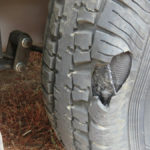


You usually do not get much warning before a trailer tire lets go. One minute the rig feels planted, the next you hear the bang, see rubber flying in the mirror, and start wondering what other damage just happened to the fender, wiring, or trailer siding. If you are asking what causes trailer tire blowouts, the short answer is heat. The real answer is that several towing mistakes and equipment problems create that heat until the tire fails.
Trailer tires live a harder life than most truck tires. They scrub through tight turns, sit for long periods, carry heavy loads, and often age out before they wear out. That is why trailer tire blowouts are usually not random bad luck. Most are preventable if you know what to watch.
What causes trailer tire blowouts most often?
The biggest cause is underinflation. A trailer tire that is even modestly low on air flexes more as it rolls. That extra flex builds heat in the sidewall and internal structure. Keep towing long enough at highway speed, especially in summer, and the tire can come apart.
This is where many owners get fooled. A trailer tire can look close enough by eye and still be dangerously low. Unlike a truck with steering feedback, a trailer will not always tell you something is wrong until the tire is already failing.
Overloading is right behind underinflation. Every tire has a load rating, and that rating assumes the tire is inflated to the pressure required for that load. If your enclosed trailer, horse trailer, camper, or equipment trailer is carrying more than the tires are rated for, the tire runs hotter and works beyond its design. Sometimes the trailer is overloaded overall. Other times one side or one axle is carrying too much because the cargo is not balanced well.
Speed is another major factor. Many trailer tires are not designed to be run far above their rated speed for long stretches. A lot of tow rigs can comfortably cruise faster than the trailer tires really want to go. Add summer pavement temps, a heavy load, and a little low pressure, and you have a recipe for a blowout.
The hidden problems behind trailer tire failures
Tire age is a big one. Trailer tires often look fine long after they should have been replaced. Good tread does not mean a healthy tire. UV exposure, weather, sitting loaded in one spot, and long periods of inactivity all dry out the rubber and weaken the internal construction. For many trailer owners, age gets the tire before mileage ever does.
That is especially common with RVs, horse trailers, and seasonal haulers. The trailer may only make a handful of trips each year, so the owner assumes the tires are still good. But a seven-year-old trailer tire with plenty of tread can be far more dangerous than a newer tire with some wear.
Impact damage also gets overlooked. Hitting potholes, curbs, road debris, or rough shoulders can bruise the internal structure of the tire. You may not see the damage right away. Then, later at highway speed under load, the weakened area gives up.
Poor alignment and suspension wear can contribute too. Bent axles, worn equalizers, bad springs, and misalignment can make one tire carry more load or scrub abnormally. That creates heat and uneven wear. If one trailer tire keeps running hotter or wearing faster than the others, do not just replace the tire and move on. Find out why.
Why trailer tires fail differently than truck tires
Trailer tires are built for carrying load, not driving or braking like your pickup tires. They deal with side-loading in turns and a lot of drag during backing and maneuvering. In tight campsites, fuel stations, and driveways, trailer tires can scrub hard across pavement. That stress adds up.
A tandem-axle or triple-axle trailer can be particularly tough on tires in low-speed turns. One axle wants to roll a different path than the other, so the tires twist and scrub. That does not usually cause an immediate blowout by itself, but it contributes to cumulative damage and wear.
There is also a difference between a tire that goes flat and a true blowout. Many so-called blowouts start as a puncture, slow leak, or belt separation. The tire loses pressure, gets hot, and then catastrophically fails. By the time you hear the bang, the original cause may have happened miles earlier.
Common owner mistakes that lead to blowouts
A lot of trailer owners check tire pressure when the tires are warm, guess at the proper PSI, or use the truck door-jamb sticker as a reference. None of that helps. Trailer tires should be inflated based on the tire and trailer requirements, and checked cold before travel.
Another mistake is mixing tire types, sizes, load ranges, or ages on the same trailer. That can create uneven load carrying and different heat behavior across the axles. One weak tire in a set can be the one that fails first and starts the whole mess.
Cheap replacement tires are another trap. Price matters, but not as much as construction quality, load rating, and real-world reliability. A bargain tire that barely meets the load requirement is not much of a bargain when it shreds a wheel well or takes out brake wiring on the interstate.
Running close to max capacity all the time is also hard on trailer tires. Technically, you may be within the rating. In real life, road heat, speed, uneven loading, and sharp turns add stress. Some margin is smart.
How to prevent trailer tire blowouts
The first job is simple: know the real weight of your loaded trailer. Not the brochure weight, not the empty weight, and not a guess. Weigh it as you actually tow it, including water, feed, tack, tools, fuel, gear, or whatever else you carry. Then compare that weight to your axle ratings and tire ratings.
Next, maintain cold tire pressure religiously. Check it before every trip, not after the first fuel stop. Use an accurate gauge. If your trailer sits for weeks, check pressure before it moves again.
Inspect the tires closely. Look for cracking, bulges, uneven wear, exposed cords, or anything embedded in the tread. Put a hand on each tire during travel stops and compare temperatures carefully. If one tire is much hotter than the others, something is wrong.
A tire pressure monitoring system is one of the best upgrades you can make on a towing rig. It can alert you to a pressure loss or overheating tire before it becomes a blowout. For anyone hauling horses, RVs, or valuable equipment, that warning can save a lot more than a tire.
It also pays to replace aging tires before they force the issue. Exact replacement timing depends on use, storage, climate, and tire quality, but waiting until visible damage appears is too late. Trailer tires are not the place to stretch every last season.
What about speed, heat, and long highway runs?
This is where experience matters. A trailer that tows fine for 30 miles at moderate speed may become a different animal after two hours on hot pavement at interstate pace. Heat builds over time. So does internal fatigue.
If you tow heavy in hot weather, slowing down even a little can make a real difference in tire temperature and survival. The same goes for stop-and-check habits. Walk around the trailer at fuel stops. Look at the tires, touch the hubs carefully for abnormal heat, and catch a problem early.
There is also a trade-off with load range. A higher-capacity tire can provide useful margin, but only if the wheel is rated for the pressure and the rest of the trailer setup supports it. Bigger numbers alone are not the answer. The complete tire, wheel, axle, and suspension package has to make sense together.
When a blowout happens, the tire was not always the only problem
A failed bearing, dragging brake, or bent suspension component can overheat a tire and make it look like the tire was the root cause. Sometimes it was. Sometimes the tire was the final victim of another mechanical problem.
That is why the smart move after a blowout is not just slapping on the spare and buying one replacement. Inspect the wheel, brake components, wiring, fender area, and suspension. If the failed tire shows odd wear or severe heat damage, treat that as evidence, not bad luck. https://mrtrailer.com/tuson-tire.htm
Serious towing comes down to habits. Good tires, correct inflation, realistic loading, sensible speed, and real inspections beat roadside repairs every time. If you want proven towing gear, tire monitoring systems, and trailer equipment that holds up in the real world, visit our store at https://Store.MrTruck.com.