


A trailer tire can look fine in the driveway and still be one hot highway mile away from trouble. Unlike the tires on your pickup, trailer tires often sit for long stretches, carry heavy loads, scrape curbs, and receive far less attention. Knowing how to check trailer tires before every tow is one of the simplest ways to prevent a ruined trip, damaged trailer, or dangerous loss of control.
This is not a once-a-year job. Give the tires a quick walk-around before every trip, then perform a closer inspection before a long RV run, a loaded equipment haul, or any trip carrying horses or livestock.
How to Check Trailer Tires Before Every Trip
Start with the trailer parked on level ground, unloaded if practical, and with the tires cold. Cold means the trailer has been parked for at least three hours or has not been driven more than a mile at low speed. Pressure readings taken after highway travel will be higher and are not the numbers you use to set inflation.
Walk around the trailer and look at every tire, including the spare. A tire that is visibly low, bulged, cut, or sitting unevenly deserves attention before the trailer moves. Do not assume the other tire on that side will carry the load safely. On a tandem-axle trailer, one low tire overloads its mate quickly.
Use a quality tire-pressure gauge, not a boot or a quick glance. Compare the reading with the pressure specified for the tire and the load it carries. Many special trailer, or ST, tires are intended to run at their stated maximum cold pressure when they are carrying their rated load. But tire pressure is not a guess, and it is not based on the pressure listed on your truck door sticker. Verify the tire manufacturer’s load-and-inflation guidance, and never exceed the pressure rating of the wheel or valve stem.
While you are down there, inspect the valve stem and cap. Cracked rubber stems, corroded metal stems, or missing caps can cause slow leaks that show up after the trailer is loaded. A cap helps keep dirt and moisture out of the valve core. It is cheap insurance.
Check the Tread, But Do Not Stop There
Tread depth matters, especially in wet conditions, but trailer tire failures often start in the sidewall or inside the tire rather than in the visible tread. Look across the entire tread face for uneven wear.
Wear concentrated in the center usually points to overinflation. Both outside edges wearing faster can indicate underinflation. One-sided wear may mean an axle alignment issue, bent axle, worn suspension component, or a wheel bearing problem. Cupping, scalloped wear, or patches that look scrubbed can also point to suspension or balance trouble.
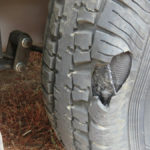
Run your hand lightly across the tread if it is safe to do so. Raised sections, separated belts, and irregular lumps may be easier to feel than to see. If the tire has a bubble, a belt separation, exposed cords, a deep cut, or a puncture near the sidewall, take it out of service. A plug is not a proper answer for every trailer tire injury, particularly on a heavily loaded trailer.
Inspect the Sidewalls Closely
Sidewalls tell the real story on trailers that spend a lot of time parked outdoors. Check both the outside and inside sidewall whenever access allows. Look for cracking, dry rot, weather checking, bulges, abrasions, and rub marks from the fender, frame, brake line, or suspension.
Fine surface cracking may appear minor, but it is a warning that the rubber is aging. A deep crack, exposed fabric, or any bulge means replacement, not another trip. Tires deteriorate from sunlight, ozone, heat, and long periods of inactivity. That is why a lightly used trailer can have unsafe tires even though the tread still looks nearly new.
Check the Tire’s Age and Load Rating
Every trailer owner should know how to read the DOT date code. On one sidewall, usually near the DOT marking, you will find a four-digit number. The first two digits identify the week the tire was made, and the last two identify the year. For example, 1824 means the tire was manufactured in the 18th week of 2024.
The date code may be on the inboard sidewall, so you may need a flashlight, a mirror, or to crawl under the trailer. It is worth the effort. A tire’s age is as important as its tread depth.
There is no one replacement age that fits every trailer. Storage conditions, climate, loading, tire construction, and use all matter. Still, a practical rule is to inspect tires carefully once they reach five years old and take aging seriously by seven years, especially on trailers stored outside in hot sun. If the tire is around a decade old, replacement is the smart move even if the tread looks respectable. Horse trailer and RV owners should be particularly conservative. The cost of a tire is small compared with the damage a blowout can cause to a living quarters trailer, fender, wiring, or the animals inside.
Also read the tire size, load range, and speed rating. Your tires must have enough combined load capacity for the actual loaded trailer weight, with margin left over. Do not size a tire from empty trailer weight or from the trailer’s sales brochure. Load the trailer as you normally would, including fuel, water, tools, tack, cargo, and gear, then get it weighed.
A common mistake is replacing a failed tire with whatever local shop has in the right diameter. Same size does not always mean same capacity. Match the tire’s required specifications, and make sure the wheel itself is rated for the inflation pressure and load range you plan to use.
Do Not Forget the Wheels, Hubs, and Spare
Tires work as part of a system. Check wheels for cracks around the lug holes, bent rims, corrosion, and missing wheel weights. Severe rust around a steel wheel’s bead area can cause a slow leak. On aluminum wheels, look for cracks and confirm the lug nuts are properly torqued to the trailer manufacturer’s specification.
Do not use your pickup’s lug-nut torque figure as a substitute. Wheel studs, wheels, and lug nuts vary. Recheck torque after a new wheel or tire installation and after the first 50 to 100 miles, following the trailer or wheel manufacturer’s instructions.
Before leaving on a long trip, touch each hub cautiously after the first fuel or rest stop. One hub that is much hotter than the others can signal a bearing or brake problem. A hot hub can transfer heat into the wheel and tire, creating conditions no amount of air pressure can solve.
The spare needs the same care as the tires on the ground. Check its pressure, age, load rating, and physical condition. Make sure you have the correct lug wrench, a jack that can safely lift the loaded trailer, and a solid support surface or jack pad. A perfect spare does not help much if you cannot install it safely on the shoulder.
Use a Tire Pressure Monitoring System for Long Hauls
A manual inspection catches problems before departure. A tire pressure monitoring system, or TPMS, watches for trouble after you are rolling. For RV trailers, horse trailers, and equipment trailers that spend hours at highway speed, a good TPMS can alert you to a developing leak or an overheated tire before it becomes a shredded casing and a damaged trailer sidewall.
A TPMS is not permission to skip the pre-trip check. Sensors cannot spot dry rot, a sidewall bulge, incorrect load range, or loose lug nuts. Think of it as a second set of eyes during the trip, not a replacement for basic maintenance.
A Practical Trailer Tire Routine
Before each tow, check cold pressure, look for damage, and confirm the tires are not visibly low. Before major trips, inspect tread and sidewalls closely, verify the DOT dates, examine the wheels and valve stems, and check the spare. After the first stretch of highway, stop and compare tire and hub temperatures side to side.
That routine takes only a few minutes, but it is the kind of habit experienced haulers develop for a reason. Trailer tires do not give much warning when they are neglected. Check them while you are still in the driveway, when the fix is straightforward and the road is still ahead of you.